Damp does not arrive in a house the way weather arrives outside, all at once and obviously. It seeps in on schedules, one room at a time, each room for its own reason. The bathroom gets its dose in eight loud minutes every morning. The bedroom collects it silently, one sleeping person at a time. The closet never makes any moisture at all and still manages to smell like a tent, because it hoards what the rest of the house produces.
We make a small dehumidifier, so we spend an unusual amount of time thinking about where household water actually comes from. The map every buyer deserves before choosing any machine, ours included, runs room by room and source by source, with the fixes in the order worth trying. Some of those fixes cost nothing. Where a fix is a machine, we say which kind, and it is not always ours. For the question of how big, our honest sizing guide goes deeper than this page does.
The two rules that govern every room
Before the tour, two facts hold everywhere, and both come from the public health guidance rather than from us.
The first is the band. The EPA advises keeping indoor relative humidity below 60 percent, and ideally between 30 and 50 percent. That band is where rooms feel fresh, windows stay clear, and the conditions mold needs simply do not assemble. Every fix below serves that band, and our year-round humidity guide covers how to hold it through the seasons.
The second is the clock. The EPA's mold guidance is blunt on this point: wet or damp materials dried within 24 to 48 hours will, in most cases, not grow mold. That window is the difference between an incident and a problem. A spill, a leak, a soaked doormat, a shower wall: none of these is dangerous by itself. What is dangerous is the same surface still being wet on the third day.
Damp is not an event. It is a schedule. Every room in a house gets wet at a predictable time, from a predictable source, and that predictability is the whole opportunity.
Keep both rules in mind and every room below becomes a smaller, more solvable puzzle.
The bathroom: the loudest source
No mystery here. A hot shower turns water into vapor on purpose, and an ordinary bathroom receives that vapor in a burst, twice a day, into the smallest airspace in the house. The fog on the mirror is the visible fraction. The rest condenses on tile, paint and the window frame, or drifts out the door into the hallway.
The order of fixes matters, and the first one is free. Run the exhaust fan during the shower and for a while after, with the bathroom door closed, so the vapor leaves through the roof instead of touring the house. The EPA lists exactly this among its core moisture controls. If the fan is broken or the room has none, that is the first money to spend, before any machine.
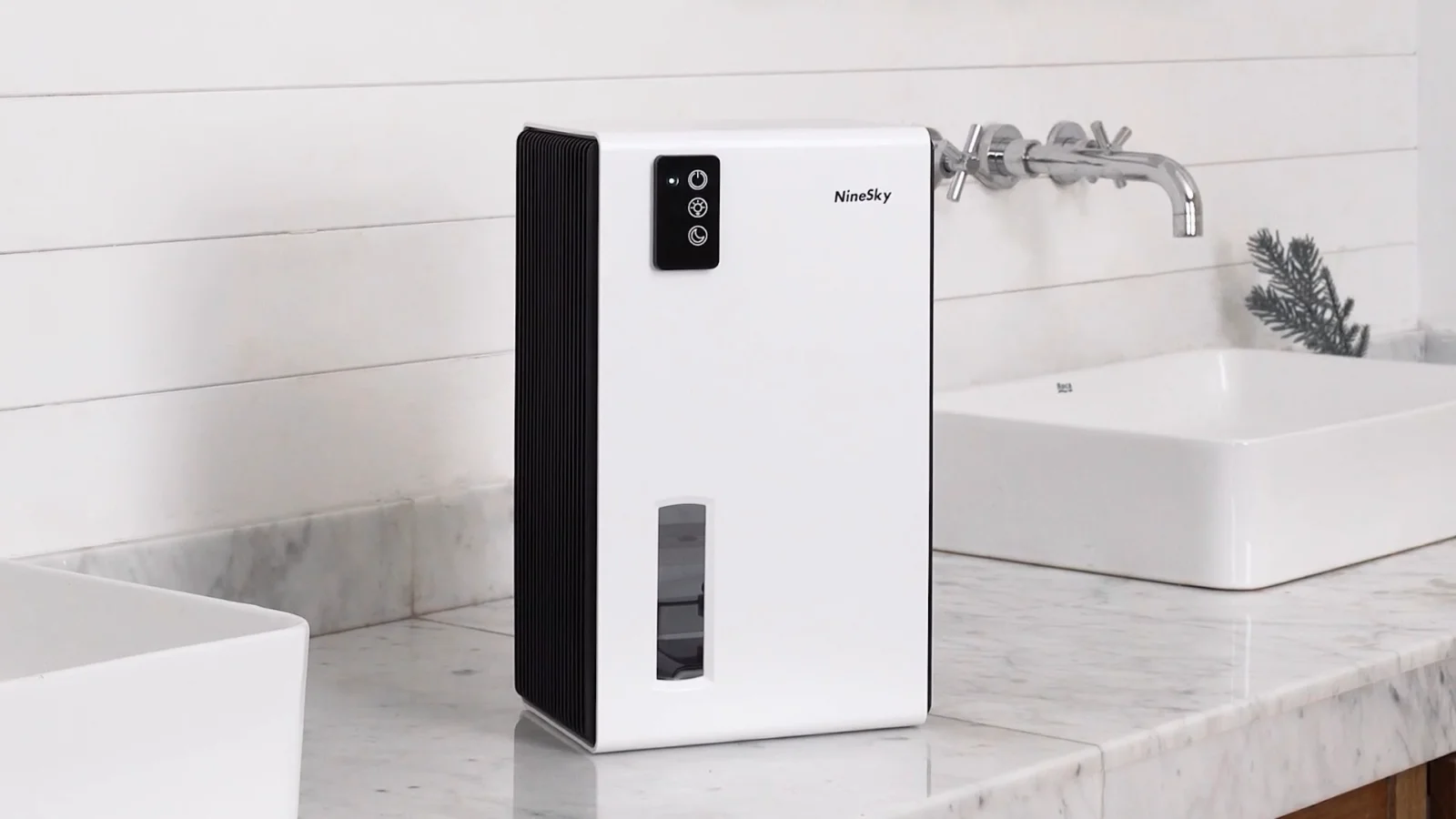
The machine's job in a bathroom is the residue: the damp that stays after the fan has done the burst. A small unit on the counter or a shelf, run for a few hours after the morning rush, keeps towels drying and grout dry. This is honestly the CT2's home game, and it is why so many of the reviews on our front page mention bathrooms. It is also worth saying when it is not enough: a windowless bathroom in daily family use, with no working fan, will defeat any tank-based machine by volume. Fix the fan first.
The bedroom: the patient source
A sleeping adult exhales moisture all night, every night. Two adults, a child who migrates in at 3 a.m., a dog by the door: a bedroom hosts its own small weather system for eight hours with the door mostly closed. Nothing about this is a defect. It is simply respiration, arriving on the most reliable schedule in the house.
You notice bedroom damp at the window first, because glass is the coldest surface in the room. The EPA's mold course describes the mechanism plainly: warm humid air meeting a cold surface condenses. Morning droplets on the inside of the pane are the room telling you its overnight humidity peaked past what the glass could carry.
Bedroom fixes, in order. Crack the door or a window when weather allows, because stale air is concentrated air. Keep heavy curtains a little clear of the glass so the coldest surface is not also the least ventilated. And if the mornings stay wet, this is the second natural home for a small quiet machine, with two conditions that matter more here than anywhere: it must be quiet enough to sleep beside, and its lights must go off. We tuned night mode for exactly this room, and the one review we quote most often was written by a light sleeper.
The closet: the room that never dries
The closet produces nothing and forgives nothing. Air barely moves in it, sunlight never enters, and the walls it shares are often exterior ones, which makes them cool. Whatever humidity wanders in stays, and fabric is the most absorbent thing in the house. The result is the familiar closet smell, which is not the smell of clothes but of air that has not moved for a week over slightly damp cotton.
MedlinePlus, the National Institutes of Health's plain-language service, notes that molds grow best in warm, damp conditions and that damp spots in a house are where they start. A closet rarely gets past musty into visible mold, but musty is already the same process at a polite volume.
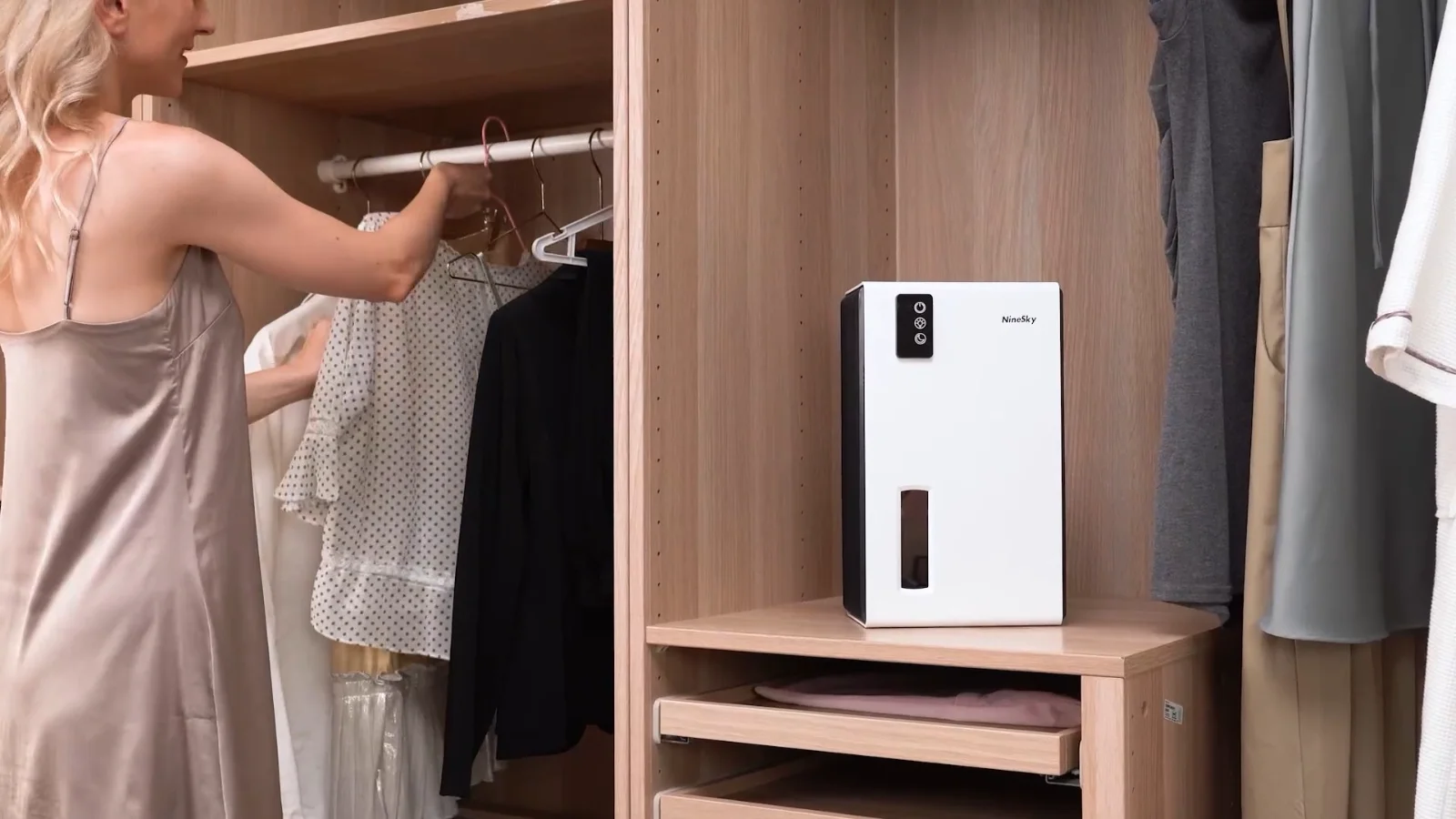
Closet fixes are mostly about circulation. Leave the door ajar when the room air is dry, keep clothes off the exterior wall by an inch, and never rack-dry laundry in there. For a walk-in that shares a wall with a bathroom, a small dehumidifier on the shelf for an afternoon a week resets the space completely. The CT2 fits a closet shelf, which is not something we can say about any compressor machine.
The kitchen: the scheduled storm
Boiling a pot of pasta releases a startling amount of water, and a rolling dinner for a family releases it every evening at the same hour. Add the dishwasher's steam cycle and a kettle or two and the kitchen rivals the bathroom for daily output, spread across more hours.
The fix hierarchy repeats. Lids on pots cost nothing and halve the output. The range hood, vented outdoors, is the built-in answer, and the EPA's guidance names venting appliances that produce moisture to the outside among the fundamentals. A dehumidifier is honestly a supporting player in a kitchen. Use one when the room stays clammy between meals, not to chase steam off a stove in real time, which no tank machine of any size does well.
The basement, the garage, and the honest referral
Below-grade rooms are different in kind, not degree. Ground moisture presses through concrete year round, there is often no sun and little airflow, and the air is cool, which raises relative humidity for the same water content. A basement that smells of earth in August is running a moisture budget the rest of the house never sees.
Here is where our own catalog page ends and a referral begins. The CT2 removes up to 34 ounces a day under warm, very humid test conditions, and cool basement air will yield less. A genuinely wet basement, with sweating walls or a floor that darkens after rain, needs a compressor machine measured in hundreds of ounces a day, plus attention to gutters and grading outside. We would rather point you at the right shelf than sell you a disappointing weekend. The full arithmetic on where that line falls is in our sizing guide, which was written for exactly this decision.
Garages and seasonal spaces sit in between. A dry-climate garage needs nothing. A garage where a wet car drips every evening behaves like a slow leak, and benefits from the same triage: ventilation first, then heat if the space is cold, then extraction sized to the actual water.
The small standing sources: plants, tanks and drying racks
Between the big scheduled sources and the structural ones sits a category most people never audit: the things that release water gently, all day, on purpose. None of them is a problem alone. Together, in a closed room, they set the baseline the scheduled bursts land on top of.
Houseplants transpire most of what you pour into them, and a windowsill of pots is a slow humidifier, which is lovely in a dry January and unhelpful in a muggy August. An aquarium is an open water surface with a heater under it, which is to say a deliberately warmed evaporation pan. A drying rack of laundry releases roughly the water the wash cycle left in the fabric, which is measured in cups, not drops, and it releases all of it into whichever room the rack stands in. Even the kettle left simmering, the uncovered stock pot, the mop bucket cooling by the door: each is small, and a house is a sum of smalls.
The audit takes one walk with honest eyes. Count the open water surfaces, count the fabric drying indoors, and cluster what you can. Plants grouped in the brightest room concentrate their moisture where ventilation is usually best. Laundry dried in the one room with a machine running beats laundry distributed over three radiators. None of this asks you to give anything up. It asks you to put the sources where the removal already is.
Renters, and the fixes that move out with you
Half the mail our support desk answers comes from people who cannot change the building: no new bathroom fan, no vent through a wall they do not own, no regrading of a landlord's downspouts. Renting narrows the toolkit, but the remaining tools are the portable ones, and they cover more ground than the lease suggests.
Everything in the habits column works in any tenancy: lids, shorter and cooler showers, the after-shower door protocol, laundry timed to open-window weather, furniture pulled an inch off the coldest wall. The hygrometer is yours and travels. So is a small dehumidifier, which is, frankly, the appliance category renting was made for: nothing to install, nothing to vent, one outlet, and it moves out in the same box it moved in. When a landlord does need to hear about a problem, a fortnight of humidity readings makes a better letter than an adjective does. A note that the bedroom held 68 percent across two dry-weather weeks is the kind of specific that gets fans repaired.
Reading a room before treating it
You can diagnose most rooms with a ten-dollar hygrometer and your own eyes, and it is worth doing before spending on any fix. The signs stack in a rough order of urgency.
| Sign | What it usually means | How urgent |
|---|---|---|
| Morning fog on windows | Overnight peak past the glass's carrying point | Watch it: fine occasionally, a pattern if daily |
| A musty smell in still rooms | Air not moving over slightly damp fabric or paper | Fix circulation this week |
| Hygrometer steady above 60 percent | The room is above the EPA band, mold's preferred territory | Act now: source, ventilation, extraction |
| Condensation on a wall or cold pipe | A cold surface meeting humid air, per the EPA's mechanism | Act now, and check what is behind the surface |
| Visible spotting on paint or grout | The 24-to-48 hour window was missed, repeatedly | Clean and fix the moisture source, not just the spots |
Two habits make the readings meaningful. Take them at the same times daily, because humidity swings by hour, and take them in the room you are treating rather than the hallway. The number that matters is where the damp lives.
The order of operations, whatever the room
Every room above got the same medicine in the same order, so here it is once, explicitly.
- Stop the source you can stop: lids, shorter showers, laundry dried outdoors or vented, plants consolidated.
- Move the air: exhaust fans during the event, doors and windows open when the outdoor air is drier.
- Warm the cold surfaces where you can, because condensation needs a cold landing site.
- Extract what remains, with a machine sized to the actual water, not to the anxiety.
- Time any incident against the 24-to-48 hour clock, and dry it fully inside that window.
The expensive mistake is starting at step four. A dehumidifier bought to fight an open moisture source is a tank being filled by a running tap: satisfying to empty, but the tap wins. Do the free steps first and the machine you eventually buy can be smaller, quieter and cheaper, which is, transparently, the kind we make.
The seasonal spaces: RVs, cabins and long-parked cars
A special word for the spaces that spend months closed. An RV in winter storage, a summer cabin in the off-season, a car parked for a long trip: these are closets at building scale. No occupants, no heating, no air movement, and one good cold snap turns whatever moisture was sealed in at closing time into condensation on every cold surface. The classic spring discovery, a musty camper or a mildewed boat cushion, was decided months earlier, on closing day.
The closing-day routine is the whole fix. Dry the space genuinely before sealing it: run heat and ventilation for a day, empty water tanks and traps where freezing is not a concern, leave interior doors and cabinet fronts open so the air inside is one volume instead of twenty small ones. Lift cushions and mattresses on edge so both faces breathe. In storage with power available, a small dehumidifier on a few hours a day keeps the sealed volume honest through the shoulder months. Where there is no outlet, moisture absorber tubs are the right tool at last, one per enclosed volume, replaced on a calendar rather than on faith. And the first visit of spring should open everything before judging anything, because a space that airs for an afternoon tells you the truth about how it wintered.
Where the CT2 fits on this map
To say it in one place plainly: the CT2 belongs in the bathroom after the fan has done its work, in the bedroom overnight, in the closet on a weekly reset, in the clammy office, and in the kitchen that stays humid between meals. It does not belong in a flooding basement or a two-story open plan, and nothing on this site will suggest otherwise. One machine, placed where its 34 honest ounces line up with a room's honest output, disappears into the routine of a dry house, and that disappearing act is the entire product.
For what the band feels like across a full year, and the seasonal rhythm of holding it, read on to the year-round guide. For every figure on this site and its birthday, the update log is one click away.
Keep reading
- What a Small Dehumidifier Honestly Does: Sizing Without the Disappointment. Our CT2 pulls up to 34 ounces of water a day with a thermoelectric core. That is exactly enough for some rooms and honestly not enough for others. Three questions tell you which room is yours before you spend.
- Living at 30 to 50 Percent: A Year of Indoor Humidity, Managed. The EPA band for indoor humidity is 30 to 50 percent. Holding a home inside it is a routine, not a purchase. Here is the year, season by season, with the readings that matter.
- Or go back to the NineSky CT2 and the full range on the front page.
