Somewhere in your home, right now, there is a number you have probably never measured. It moves hour by hour, it decides whether your windows weep and your towels dry, it has an official healthy range published by the EPA, and holding it steady costs less effort than almost any other improvement a home can get. The number is relative humidity, the range is 30 to 50 percent, and this is the guide to living inside it for a full year.
We make a dehumidifier, so we will not pretend to be neutral about the subject. But most of the year-round work involves no purchase at all: a ten-dollar gauge, a handful of habits, and a working sense of what the number means. The machine enters late, in the seasons and rooms where habits stop being enough. That order, habits first and hardware second, is the same one our room-by-room guide uses, and it is the order that keeps hardware small.
What the number actually measures
Relative humidity is the amount of water in the air, expressed as a percentage of the most that air could hold at its current temperature. The relative part is what trips people. Warm air holds more water than cold air, so the same absolute moisture reads as a lower percentage on a warm afternoon and a higher one in the cool of night. Nothing entered or left the room. The thermometer moved, and the percentage followed.
Two everyday consequences fall out of that definition, and both come straight from the EPA's mold course. First, condensation: when humid air touches a surface cold enough, its local capacity shrinks until water has nowhere to go but out, onto the glass or the pipe or the wall. A fogged window is relative humidity hitting 100 at one cold spot in a room whose gauge might read 55. Second, the cold-room paradox: basements feel damp partly because they are cool, and the same water that would be unremarkable upstairs pushes a cool room's percentage into the musty zone.
The healthy band, per the EPA, is below 60 percent and ideally 30 to 50. Below about 30, homes turn static-prone and throats notice. Above 60, MedlinePlus's description of mold's preferences begins to apply: molds grow best in warm, damp conditions, and damp spots are where they start. Between those walls sits the band where wood furniture, respiratory systems and window frames all quietly do their best.
One more translation, because it pays for itself daily. When a weather report says 90 percent humidity on a cool morning, it is describing air that may carry less total water than a 50 percent summer afternoon. Bring that cool outdoor air inside and warm it, and its relative reading drops, and that is why winter ventilation dries a house even when the forecast sounds soggy. The house and the sky keep separate books, and the gauge on the shelf is the only one reading yours.
Buy the gauge before any opinion
Everything else on this page depends on measurement, so the first move is a hygrometer, which costs about as much as lunch. Two of them are better, because the point is comparison: one in the suspect room, one in the main living space. The habits that matter are the same ones we use when reading our own rooms.
- Read at consistent times, morning and evening, because humidity has a daily rhythm and a single random reading is weather trivia, not information.
- Read where the problem lives. The hallway average does not tell you what the closet is doing behind its shut door.
- Watch trends, not spikes. A shower will spike any honest bathroom gauge. What matters is whether the room is back under 50 by lunchtime.
- Write nothing down and you will remember nothing: a note on a phone, twice a week, turns the number into a story you can act on.
A hygrometer is the cheapest appliance in the house and the only one whose entire job is telling you the truth. Everything it says, it says before the window fogs and long before the closet smells.
With a month of readings, you know your home's personality: which rooms run wet, which season breaks the band, and whether your problem is a schedule, a room, or a climate.
Winter: the condensation season
Winter damp is a paradox. Cold outdoor air is dry, indoor heating dries it further, and plenty of homes spend January below 30 percent, at the static-shock end of the band. Yet winter is also peak window-weeping season, because the gap between indoor warmth and a freezing pane is at its widest, and every pane becomes a condensation machine.
The winter playbook is therefore about surfaces more than air. Keep air moving along cold glass: curtains slightly clear of the pane, trickle vents open where they exist. Watch the room behind the wardrobe on an exterior wall, the classic winter mold corner, and give it an inch of breathing gap. If the gauge reads dry but the windows still weep, the problem is surface temperature, not the air, and no dehumidifier fixes cold glass. Heavier curtains closed at night and warmer room air do more.
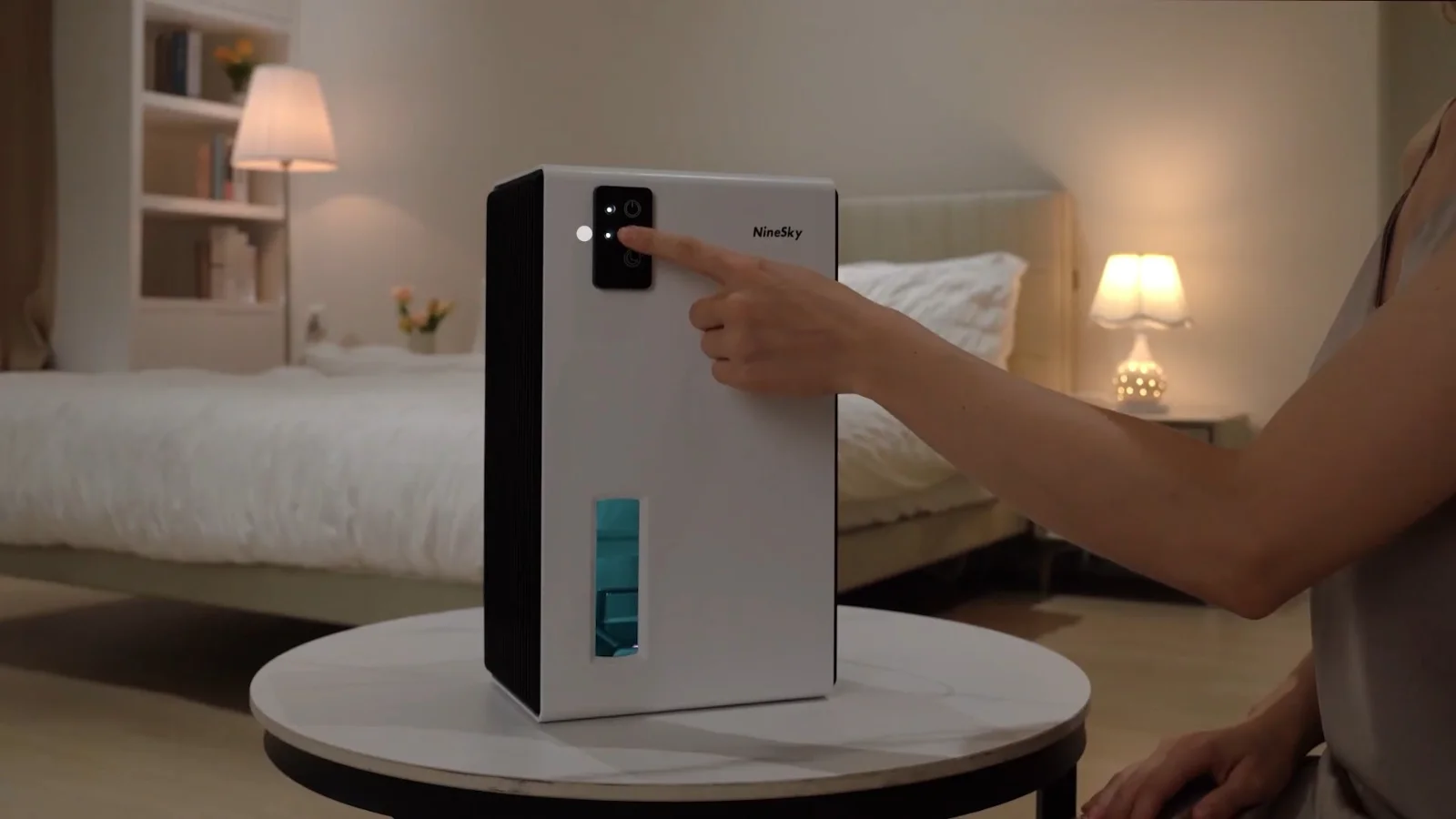
Where winter genuinely breaks the band upward is the localized burst: laundry drying indoors because the line is frozen, a bathroom whose fan struggles, a kitchen running a holiday's worth of pots. Those are exactly the small, warm, closed rooms where a compact machine earns its keep for a few hours, and the CT2's night mode was tuned with exactly the winter bedroom in mind.
Spring and fall: the swing seasons
The shoulder seasons are when the gauge earns its money, because outdoor air changes character weekly and the house lags behind it. A warm rain week in April can push indoor readings past 60 in a house still running winter habits, and a dry October week can drop them back before anyone notices.
The swing-season rule is simple: ventilate on the dry days, contain on the wet ones. When outdoor air is drier than indoor, opening windows is free dehumidification, and the EPA's moisture guidance lists exactly this kind of ventilation among its fundamentals. When a rainy spell inverts the relationship, the same open window imports the problem, so the house closes up and extraction carries the load. This is the season our support desk sees the most puzzled mail, and the answer is nearly always the same: check what the outdoor air was doing the week the readings jumped.
Spring also opens the annual maintenance window. Gutters, downspouts and grading move rain away from foundations before summer humidity arrives. The EPA's guidance treats outdoor drainage as indoor moisture control, and it is right.
Summer: the endurance season
Summer is when the band is hardest to hold, because the source is the climate itself. Warm outdoor air arrives loaded, every opened door restocks the supply, and cooling surfaces sweat. In much of the country, July indoor readings drift toward and past 60 percent in any room without help.
Air conditioning is the heavyweight here: cooling air wrings water out of it as a side effect, and a well-sized system holds living spaces in the band on its own. The rooms that fall through are the ones conditioning reaches weakly or not at all: the bathroom with its door closed, the bedroom whose vent whispers, the closet, the small office over the garage. Those satellite rooms are small-machine territory all summer, one continuous airspace at a time, and the sizing arithmetic for them lives in our honest sizing guide.
Summer is also tank season. A machine that needed emptying weekly in May may want it every other day in August. The CT2's 95-ounce tank and its shut-off exist so the worst case of a forgotten pour is a stopped machine, never a wet floor.

The year at a glance
| Season | What the gauge does | The lead move | Where a small machine helps |
|---|---|---|---|
| Winter | Low averages, cold-surface condensation | Warm the surfaces, mind the wardrobe corner | Laundry rooms, bathrooms with weak fans |
| Spring | Weekly swings with the weather | Ventilate dry days, close up wet weeks | Rooms that lag the swings, closets |
| Summer | Steady upward pressure past 60 | Air conditioning plus closed-room extraction | Bedrooms, baths, closets, small offices |
| Fall | The retreat: swings, then dryness | Reverse spring, watch the first heating days | Shoulder-week bedrooms, storage rooms |
Four seasons, one band, and the same short toolkit rearranged: measure, ventilate or contain by the day, warm the cold surfaces, extract in the rooms that need it.
Rooms with their own rules
The band is one number, but a few rooms deserve their own footnotes, because what lives in them changes what the number costs when it drifts.
The nursery and the bedroom of anyone with sensitive airways sit at the top of that list. MedlinePlus is direct about who notices mold first: people with allergies and asthma, whose reactions damp rooms can trigger. For those rooms we treat 60 percent not as the edge of the band but as an alarm line, and the fixes lean toward the silent ones: ventilation on dry days, cold surfaces warmed, and if a machine is needed, one chosen for its night manners. A dehumidifier in a child's room must be boring: quiet, lights out, and incapable of overflowing. We tuned ours accordingly, and the shut-off exists precisely for rooms where nobody is watching the tank.
Wood has its own constitution. Furniture, floors, guitars and pianos all breathe with the seasons, swelling in humid months and shrinking in dry ones, and the band is where that movement stays small enough not to matter. What wood hates is not any single reading but the whiplash, the fast swing from a wet week to a heated dry one. Instrument owners have known this forever. It is the reason the case hygrometer predates the home one. If the house holds 30 to 50 with slow transitions, the sticking drawer in July and the gapping floorboard in January both fade into memory.
Wardrobes and book walls, finally, are the band's silent beneficiaries. Fabric and paper are the most absorbent things a home contains, and they buffer the room around them: soaking up the humid weeks, releasing through the dry ones. That buffering hides trouble. A closet can smell fine in the humid week the readings spiked and turn musty a fortnight later as the stored moisture works out of the cotton. The fix is the one from the swing seasons, applied at furniture scale: air the enclosed volumes on the dry days, and give the packed shelf an inch of gap so the buffer can actually release.
The mistakes a gauge catches
A year of readings also catalogs the classic self-inflicted wounds, and it is cheaper to read about them than to log them yourself. Four appear in our mail more than all others combined.
The first is drying laundry indoors as a habit rather than an exception. One rack is a liter or so of water released into one room. A family's weekly wash, dried inside through a rainy month, is a standing source the size of a small leak, and no bedroom machine is sized for it. The gauge shows it as a reading that never quite comes down between wash days.
The second is furniture flush against exterior walls. The wall's cold face plus trapped still air builds a micro-climate the room's gauge never sees, and the discovery is usually made while moving house. An inch of gap costs nothing and lets the wall breathe. Behind wardrobes on north walls it is the difference that decides whether spring cleaning includes a repaint.
The third is the unheated room kept shut all winter: the guest room, the box room, the study nobody uses until March. Cool air needs less water to read damp, and a closed door removes the ventilation that would bail it out. Either heat such rooms a little and crack the door, or accept them as seasonal storage and prepare them the way the RV owners in our room-by-room guide prepare a camper for winter: dried first, opened up inside, checked on the first warm day.
The fourth is chasing single readings. One 64 percent evening after a pasta dinner is not a mold emergency, and one 42 percent afternoon does not mean the problem is solved. The band is a habit, not a scoreboard, and every action worth taking shows up as a two-week trend. The gauge's job is patience, and the reader's job is to match it.
The incidents outside the routine
A year of humidity also includes its accidents, and the band has a rule for them too. The EPA's window says materials dried within 24 to 48 hours of getting wet will in most cases not grow mold. So the burst pipe, the failed washing machine hose, the window left open to a storm: these are humidity events on a deadline. Move the water out fast, move the air hard with every fan available, and drive the room's readings back into the band within two days. A small dehumidifier contributes to the endgame of that race, drying the last stubborn percentage points. The opening laps belong to towels, ventilation and, past a certain scale, professionals with equipment sized for disasters.
The other recurring incident is the returning smell: the musty note that comes back to one room every few weeks despite decent averages. Treat it as a message about a micro-climate your gauge placement is missing, usually inside or behind something. The fix is the room-by-room diagnosis this page's sibling guide walks through, one enclosed space at a time.
What a year in the band buys you
Held for a year, 30 to 50 percent is not an abstraction. It is windows that stay clear through January, towels that dry between uses, a closet that smells of nothing, wood that stops moving with the seasons, and the quiet retirement of that end-of-summer ritual where you discover what the back of a cupboard has been growing. MedlinePlus's list of what mold exposure can do to eyes, skin, noses, throats and lungs reads, inverted, as a list of what the band protects.
Our part in it is deliberately small. One quiet machine for the rooms the climate systems miss, a tank sized for real weeks, spares kept listed at pocket-money prices, and figures that always travel with their test conditions. The rest is a gauge and a set of habits, which is the least a brand can say and, we think, the most honest thing on the subject. Every number above has its source linked below, each one read before it was cited, and the range itself is a short walk up from here: the whole of the NineSky catalog fits on one page, every finish with its own button, priced as of our last update.
Keep reading
- Where the Damp Starts: A Room-by-Room Guide to Moisture at Home. Every room gets damp for its own reason. The bathroom steams, the basement seeps, the closet just sits still. Here is where the water comes from in each one, and what actually stops it.
- What a Small Dehumidifier Honestly Does: Sizing Without the Disappointment. Our CT2 pulls up to 34 ounces of water a day with a thermoelectric core. That is exactly enough for some rooms and honestly not enough for others. Three questions tell you which room is yours before you spend.
- Or go back to the NineSky range and the full range on the front page.
